


History of Pakistan Clothing - Traveling Through Time
Culture and fashion are vital parts of any country’s history and civilization. In Pakistan, both of these are inextricably woven. To understand Pakistan’s fashion heritage, we provide this historical resource to help navigate the evolution of regional attire.
The history of traditional Pakistani silhouettes is a very colorful and interesting one.
This history not only makes for a great learning experience but also gives insight into everything you need to know to understand why Pakistani fashion is where it is today. As you’ll see, the evolution of fashion in Pakistan reflects the culture, ideologies, and growth of the Pakistani people over time.

Traditional Pakistani Silhouette in Green
Origin of Pakistani Dresses
Based on historical discoveries, Pakistani attire dates back over 7,000 years to the Bronze Age. This was during the Indus Valley Civilization era when cotton was first cultivated around 3,000 BC in the Indus River Valley, which is now present-day Pakistan.
Pakistan’s geostrategic location also played a significant role in its fashion and culture. The country is bordered by India on the east, Iran by the west, Afghanistan in the northwest, China by the northeast, and the Arabian Sea towards the south. This has made the region a central connection point for trade and civilization throughout history. However, this has also made it a significant route for cultural exchange through various centuries.
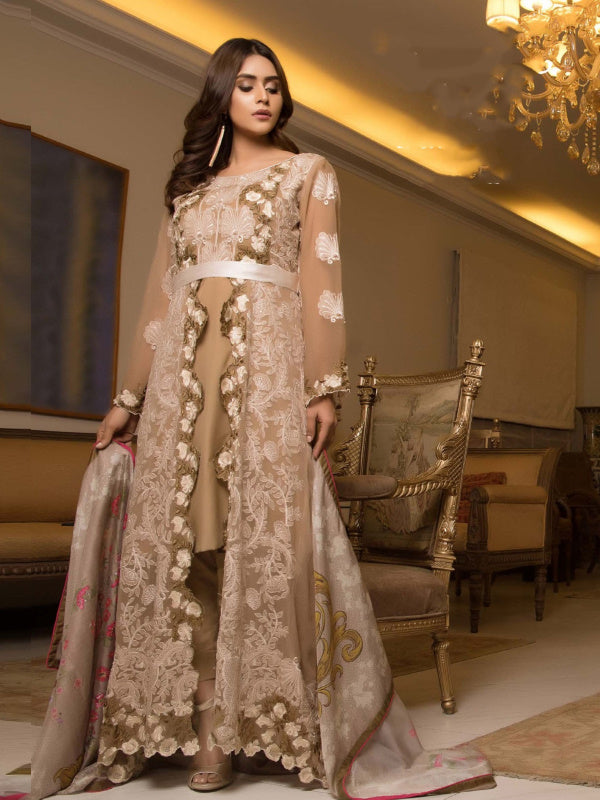
Floor length Pakistani Silhouette
Past cultural influences and settlements in Pakistan have involved diverse groups from Persians to Arabs, Turks, Mongols, Aryans, Dravidians, Greeks, and certain Eurasian groups. For the country, this has meant the marriage of many cultures, with the fashion representing a blend of Afghan and Persian elements. Along with this, fashion choices in Pakistan have been shaped by cultural and regional considerations. This marriage of heritages explains the exotic nature of traditional Pakistani garments.
Mughal Era Influence on Pakistani Fashion
The region (present-day Pakistan) saw significant shifts toward the end of the 13th century. By the 16th century, the Mughal Empire seized control and influenced the artistic landscape of much of South Asia.
The Mughals consolidated unique aesthetic standards in the region. Along with their cultural practices, the Mughals spread Persian arts and craftsmanship. This influence can easily be seen today, with the majority of Pakistani clothing being a fusion of traditional and Mughal heritages.
The Mughal era is perhaps the single most influential period in the history of Pakistani fashion. This can be seen in the contemporary costumes of Pakistan, from the classic regional attire which is the national dress, to the lehenga, turban, churidar pajamas, and pishwas.

A Pakistani Silhouette for Women
Many of these garments have their origins traceable to the Mughal era, although they have continued to evolve over time.
Origin & Evolution of The Salwar Kameez - Pakistan’s National Dress
The Salwar Kameez was introduced to the subcontinent around the 12th century. By the 16th century, when the Mughal Empire held control of the region, the garment—along with several other elements of Persian art—had become deeply rooted in the culture.
The earliest known historical form associated with this style is the Anarkali. Historically, the Anarkali silhouette was favored in royal courts for its fluid movement and grace. While the garment was originally known for its use in courtly performances, it became a legendary symbol of elegance, eventually named after the famous figure Anarkali.
The Salwar Kameez has survived centuries of evolution to remain the central heritage silhouette for both men and women in Pakistan in 2026. The Pakistani salwar is known for its long, straight cut and is usually paired with salwar or churidar trousers.

A Pair of Pakistani Heritage Silhouettes
Pakistani women often pair theirs with a dupatta that provides grace and modesty. The silhouette is designed for comfort and ease of movement. This practicality explains why it has held its place steadfastly as Pakistan's heritage ensembles after all of these years.
Modern Era Fashion in Pakistan
Pakistan’s social trajectory shifted at the turn of the 20th century. As the Mughal influence transitioned in the mid-19th century, the British Raj assumed control of the subcontinent from 1858 to 1947. These moments in history had lasting impacts on the fashion and culture of the people.
In the early 1900s, sarees and ghagras were prominent alongside the traditional salwar. After independence, the Pakistani fashion scene developed a distinct identity. Fashion became more liberal and refined around the mid-20th century, where global influences saw the introduction of shorter shirts and bell-bottom silhouettes.

Women in Pakistani Chiffon Silhouettes
Towards the end of the 20th century, lengthier silhouettes became more common. Regional considerations led to the preference for longer shirts and scarves. However, by the dawn of the 21st century, diverse styles once again flourished.
Along with the traditional salwar kameez, wide-leg pants, cigarette trousers, and modern tights all appeared on the scene. Today, in 2026, modern Pakistani fashion reflects the progressiveness and cultural nuances of this 245-million-strong population. The fashion landscape is as diverse as ever, and Pakistani women have established a distinct fashion identity that resonates globally.
← Back to Blogs


FABRICOZ HELP


